
Board exam season in India brings an immense amount of pressure. When the results are declared, discovering that your Class 10 or 12 marks fall short of your expectations—especially if you miss the crucial 75% cutoff required by top-tier universities—can feel like a major roadblock. However, standard central and state boards are not the only legitimate pathways to higher education. If you are looking to upgrade your scores, salvage your academic year, and secure a globally recognized qualification without repeating a year under the same stressful system, internationally accredited high school boards offer an incredible alternative right here in India. Here is why pursuing an internationally recognized high school diploma could be the academic turning point you need.
What Are International High School Diplomas?
Several prestigious, globally recognized educational boards (predominantly based in the United States and the UK) operate extensively within India. It allow students to earn an international equivalent of the Indian 12th-grade certificate.
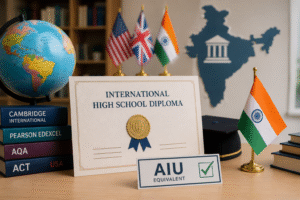
The most critical factor to look for when choosing one of these alternative pathways is Association of Indian Universities (AIU) equivalence. When an international board is granted this equivalence, the Government of India legally recognizes its diploma as entirely equal to the Senior Secondary / +2 certificates issued by central-boards like CBSE and ICSE.
Why This is a Game-Changer for Indian Students?
For students who have struggled with the traditional Indian exam format, switching to an international board offers immediate and tangible benefits:

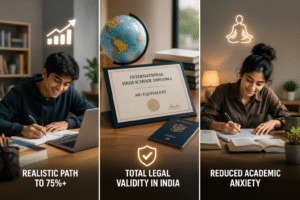
A Realistic Path to 75%+: Traditional Indian boards often rely heavily on a single, high-stakes final exam. International curriculums usually emphasize continuous assessment, practical assignments, and holistic understanding. This student-friendly evaluation method makes it significantly easier to improve your grades and cross the 75% threshold needed for competitive university admissions.
Total Legal Validity in India: With AIU equivalence, these international diplomas are valid for admission into central, state, and private universities across India, as well as forappearing in domestic competitive exams (like JEE or NEET) and applying for government jobs.
Reduced Academic Anxiety: By shifting the focus away from rote memorization and high-pressure testing, students can learn at a customized pace. This flexibility allows you to focus deeply on your core subjects without the overwhelming stress associated with standard exams.
Strategic Advantages for Higher Education
Choosing an international board over repeating a standard Indian board exam offers distinct advantages depending on where you plan to go next.
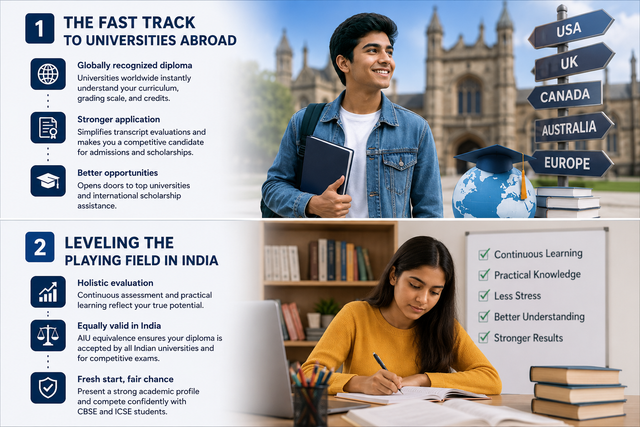
1. The Fast Track to Universities Abroad
If your ultimate goal is international education, holding an American High School Diploma (or a similar international equivalent) gives you an immediate advantage. Foreign universities instantly recognize the grading scale, credit systems, and curriculum frameworks. At Global Flamingos, we consistently see how applying with a globally accredited diploma streamlines the entire admission facilitation process. It simplifies transcript evaluations and positions you as a highly competitive candidate for international scholarship assistance, as universities prefer academic records they can easily interpret.
2. Leveling the Playing Field in India
If you plan to stay in India, an international diploma protects you from the rigid theoretical focus of domestic boards that can aggressively penalize a single bad exam day. You can present a robust academic percentage to Indian universities that accurately reflects your continuous effort and practical knowledge, giving you a fresh start and a level playing field alongside CBSE and ICSE students.
Act Fast: Navigating Summer Deadlines
If you are considering this route to upgrade your academic profile for the current year, timing is critical. Many of these international boards operate on summer enrollment cycles to help students quickly transition after domestic board results are announced. Typically, enrollments for the immediate upcoming exam cycles close by the end of May, with exams commencing in mid-June. A lower-than-expected board score does not have to dictate your academic trajectory. By pivoting to an AIU-recognized international board, you can take control of your grades, reduce your stress, and keep your dreams of attending a premier domestic or global university very much alive.